Version 1.7.4 Available Now

CoinScope Pro now does World Coins and the Ancient World. 62 countries and ancient issuers written out by hand and about 560 more with their currencies, beside the Roman lookup: 56,763 Roman and Byzantine types, searched by whatever scrap of legend you can still read. All on your own computer.

See what it does →
Examine · Measure · Grade · Catalog · Learn

Not just a microscope camera.
The whole coin bench.

Put a coin under the lens and move the light. Watch a die crack throw its shadow, measure a doubling spread in microns, and see what the wear, luster and marks say about the grade, with every number explained. Then file it with its photos, value and shelf spot, print its 2x2 label, and read up on the variety you just found. One Windows program, and your coins never leave your computer.

  • 40+tools
  • 15ways to see the surface
  • 705coins referenced
  • 0telemetry, ever
Windows 10 & 11  ·  USB microscope, webcam, capture card or your phone  ·  free 5-day trial
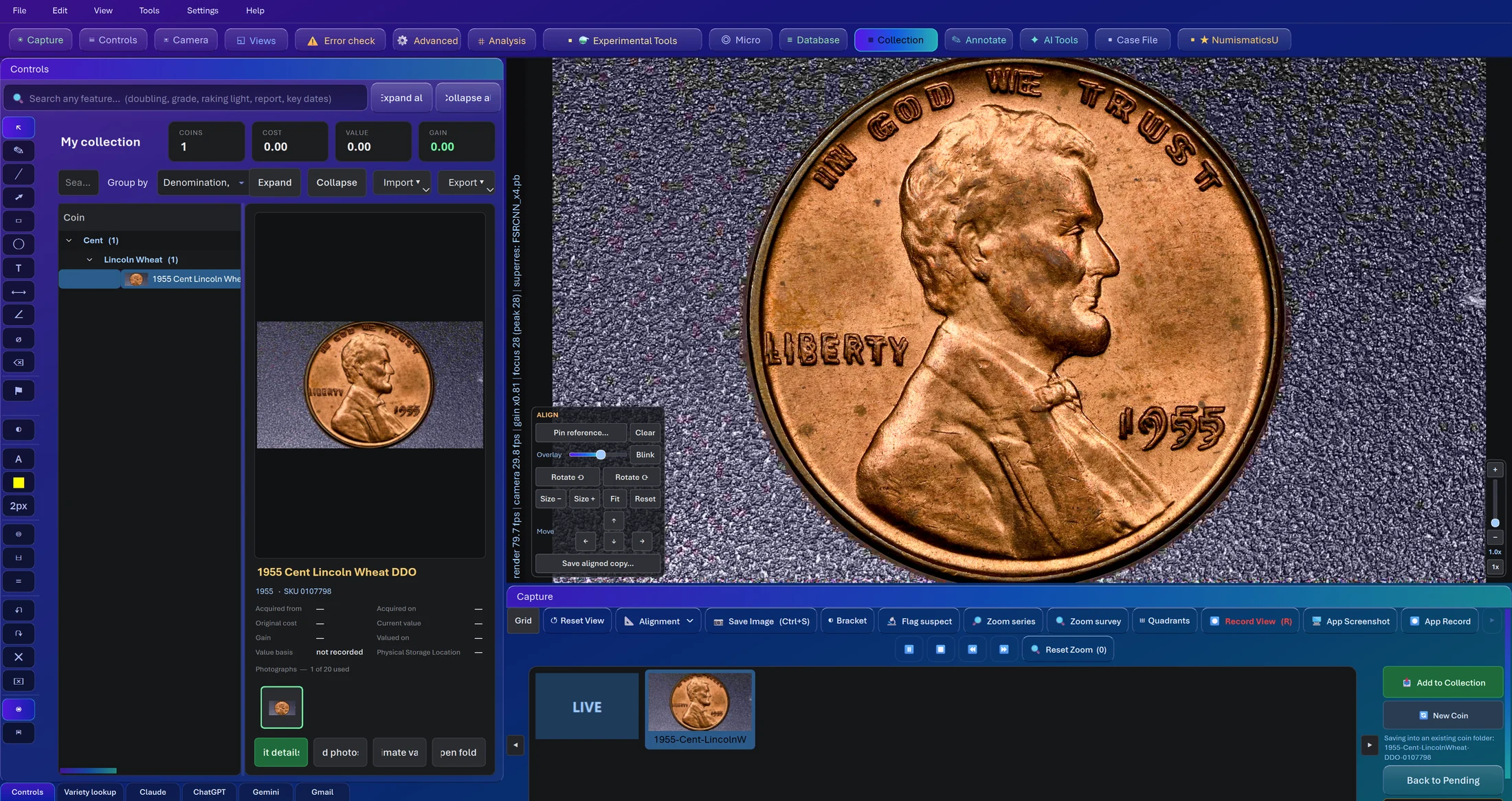
CoinScope Pro examining a 1955 doubled die Lincoln cent: live microscope view, histogram, focus meter and the coin's photograph strip
the bench, examining a 1955 doubled die cent
Examine

Light it from any angle. Fifteen renderings of the surface.

Measure

Calibrated caliper. Diameter, relief and doubling in microns.

Identify

Varieties, confirmed VAMs, die states and die marriages.

Grade

Wear, luster and marks scored, with every number explained.

Catalog

Every photograph filed to the coin, with value and location.

Sell

2x2 labels with barcodes, flip cards and listing copy.

Newly Developed! · Feature of the Month

Doubling Spot Check: See It for Yourself

You think the date is doubled. You zoom in, squint, tilt your head, and it’s still just one picture, lit one way, and a second impression can hide right in its shading. So you point at the one letter or digit you’re suspicious of, and CoinScope Pro shows you that spot seven different ways.

Seven Looks at One Letter

As photographed, local contrast, a raking light you swing around, the outline alone, surface slope, a quiet map where anything normal goes black, and color change. Each one strips away a different distraction. Something that’s really there keeps showing up; a trick of the light shows up once and disappears.

Watch the Shadow Move

Swing the lamp and watch. A raised second impression throws its own shadow, and that shadow moves as the light goes around. A flat smear of shoved metal doesn’t. You’re not being told the physics, you’re watching it happen, which is how it finally makes sense.

Then the Shape

A cross-section cut straight across the spot shows you the shape: two crests of about the same height is what hub doubling looks like, one crest and a flat shelf is machine doubling. And when the two honestly look the same, it says so instead of guessing.

It helps you see doubling. You make the call, and anything that could be worth real money still goes to a grading service. That’s the whole idea. — Jen

Version 1.7.4 · World Coins and the Ancient World

World Coins, Ancients, Tokens, Bullion and Challenge Coins

One collection for everything you own: the United States, every other country, the ancient world all the way back to the first coins struck in Lydia around 630 BC, and the tokens, bullion and challenge coins that sit beside them. The same measuring bench works on all of it, and the reference data comes inside the program. Yes, I went full Roman nerd on this one.

  • 56,763Roman and Byzantine types
  • 62countries and ancient issuers, written out by hand
  • ~560more countries and historical states
  • 10collection areas

Roman Coins, Found by Their Legend

A Roman bronze rarely shows a date, and the mint mark is often worn away. What’s left is usually a scrap of the lettering, so that’s what you search on. Type the letters you can read and partial words still match: VICTORI finds VICTORIA.

52,054 Imperial types keyed to RIC, 2,602 Republican and 2,107 Byzantine, across 173 rulers and 81 mints. Built from the American Numismatic Society’s open typology, credited in the program, and searched offline.

Every Part of the World

The collection opens by area: Whole Collection, United States, Canada & Mexico, Europe, Asia, Africa, Oceania, Central & South America, Caribbean, Ancient World and Tokens. Each area keeps its own count, cost and value.

Pick a country and the Period and Denomination lists fill in for it. Most of Europe, Russia, China, Vietnam, Japan, India, the Koreas and more are written out by hand with their periods, currencies and denominations; about 560 other countries and historical states come with their currencies, from Wikidata.

The Ancient World, on Its Own Terms

Ancient coins are filed by who issued them, not by a modern border, because nobody in Lydia was checking a map from 2026: Lydia and Ionia, the Greek city-states and kingdoms, Persia, the Roman Republic, Empire and Provincial issues, Celtic, Ancient India, Ancient China and Byzantium.

Each coin has a place for its ruler, its date as written (AH 1332, regnal year 12, undated), its obverse and reverse legends, and its references — RIC, KM#, Sear.

Numista, With Your Own Key

Look a coin up on Numista from inside its record, using your own free Numista key. The key is kept encrypted by Windows, and only the coin’s N# is saved; the details are shown marked “Source: Numista”, fetched when you ask and kept for no more than five days.

My Coins: Any Country, Any Size

Enter the specifications of any coin — diameter, weight, anything you know — and it joins the calibration list, the measuring tools and the counterfeit screen, marked “My Coins” so a figure you typed is never mistaken for a published one.

Measured Under Your Microscope

A world coin gets the same bench as a Lincoln cent: calibrated diameter in millimeters, the fifteen views of the surface, relief from a light set, the photos filed to the coin. Physics doesn’t care what country a coin came from, and neither does the caliper.

Tokens

Pick Token and you get 31 kinds to file under: Civil War and Hard Times tokens, transit, trade and casino tokens, Mardi Gras doubloons, love tokens, So-Called Dollars, elongated and encased coins, even wooden nickels.

Challenge Coins

Challenge coins get their own home too: every branch of the service, first responders, agencies, clubs and sobriety medallions.

Bullion and Private Mint Silver

Silver and gold bullion, commemoratives and private mint silver each have their own type, and melt value is worked out from the metal prices you set. It’s kept apart from what the coin is worth to a collector, because those are two different numbers.

Why It Is Worth It

A Measuring Bench, Not a Picture Viewer

Most coin software stores photos and lets you type notes beside them. CoinScope Pro measures the coin under your own microscope and tells you which of its answers are measured, which are inferred, and when it can’t tell at all. That last part is the point: it would rather say “can’t tell” than hand you a confident wrong answer about a coin you might pay for.

  • Read a worn Roman coin by its lettering. Type the few letters still legible and get the matching types from 56,763, offline. A worn bronze rarely carries anything else to search on.
  • ChatGPT and Claude, built in. Both open in the program’s own browser with your own signed-in accounts, no per-use charge. Send a coin’s photos and your question together, and paste the reply wherever you want it.
  • A record that holds up. The case file and evidence packets keep what you photographed, when, and with what settings, so a suspected error has its evidence attached rather than a memory of it.
  • Every coin you own in one place. United States, world and ancient coins in one collection, each area with its own count and value, and the value split into what comes from real sales, what is estimated and what you entered.
  • Nothing extra to buy for the reference data. The Roman types and the country lists come with the program and work without an internet connection.
Made by a Collector

Member, American Numismatic Association  ·  Member, NGC (Numismatic Guaranty Company) Collectors Society

What It Costs

$199.99, Paid Once

One license is the whole program: the measuring bench, the world and ancient coins, the collection, the labels and the reports. It never expires, updates are included for the life of the product, and it goes on three computers.

Try it free for five days first, with a free account and no card. Promo codes may be available.
How It Is Different

Facts You Can Check

  • Offline. The Roman lookup and every country list are files inside the program. No connection is needed to search them; only Numista, which you choose to use, goes online.
  • No subscription for the lookup data. The Roman types and the world lists come with the program. Numista uses your own free key.
  • Measured on your coin. Diameters are read from your own microscope after calibration, not copied from a catalog.
  • Labeled. Measured and inferred results are kept apart and named as such.
  • Value, broken down. Each area’s total says how much comes from reported sales, how much is estimated and how much you entered by hand.
  • Credited. The American Numismatic Society for the Roman types; Wikidata (public domain) for the countries and currencies.
Good to Know

A Shortlist to Start From

The Roman lookup hands you every type that matches what you can read, which is a great place to start. The attribution is yours to make with the coin in hand, and since ancient coins are forged a lot, often in exactly the easiest types to look up, a match is a lead rather than a reason to buy.

The country lists tell you what was struck and when. For prices, the value tools and your own sales records do that job.

World and Ancient Coins in Detail Download for Windows

The Lincoln Files · Lincoln Cent Die Varieties

The Lincoln Files

I’ve gazed into Lincoln’s side eye more than any other man’s in my life. He taunts me. Every coin, same profile, same look, like he knows something about the die that I don’t yet. So I wrote it all down: every Lincoln cent die variety I could document, year by year and mint by mint, with what to look for and how to photograph it. Chin down, Abe. Give me the side eye.

  • 1,328Lincoln variety write-ups
  • 100years of Lincoln cents

Open the Lincoln Files   The 2009 Bicentennial Cents

Why a Bench, Not a Camera App

A Photo of a Coin Is Nice. Examining It Is the Fun Part

Here’s the science nerd in me talking. Brightness on a coin is shape times lighting, and one photo can’t pull those two apart. A shadow next to a letter and a real second image of that letter look exactly alike in a single frame. So CoinScope Pro changes the question. Move the lamp, move the focus, turn a polarizing filter, and each set of shots carries the actual shape of the metal. Once you have the shape, doubling, die cracks and wear stop being impressions and start being things you can measure.

Light It From Anywhere

Grab a real light. Your phone flashlight counts. Hold it low to one side, take a shot, move it around, take another. Each point on the coin brightens and dims as the lamp goes round, and from that the program solves the actual tilt of the metal at every pixel, then the height. That’s photometric stereo, it takes about a minute, and it uses stuff you already own.

For a bench where the light can’t move, there’s a virtual raking lamp you can swing around one photo. It’s a simulation, labeled as one, and it’s great for looking.

Fifteen Ways to Look

Relief, micro detail, doubling scan, crack scan, contour map, flow direction, heat map, depth map, edges, negative, solarize, polarize. A contour map draws lines of equal brightness, so doubling shows up as a second contour running alongside the first. Flow direction follows the grain the strike left in the metal. Every view works on the live feed and on photos you already saved, and measurements always come from the real pixels, never from the view.

Numbers, Not Impressions

A picture has no scale, but a coin does: its diameter is a published number. Pick the type and the program fits a circle to the rim, and now every pixel has a size. It takes several readings and refuses a calibration whose readings disagree by more than 0.8%; a good one agrees within 0.3%, about 70 microns on a quarter. A stage micrometer gets you closer still. “Looks kind of wide” becomes a number you can put in a listing.

It Tells You When It’s Guessing

Tools that measure and tools that infer live on separate tabs, and the inferring ones wear pale yellow so you always know which is which. The experimental tab is where I get to play mad scientist, and you get to play along, knowing exactly what you’re looking at.

Your Photographs Stay Yours

No watermarks, no uploads. Every capture goes into your own folder, filed under its coin, with the settings that took it written down beside it. I’m a photographer. If software stamped a logo on my pictures I’d riot, so this one doesn’t.

Built on One Collection

Photos, notes, grade, provenance, the shelf it sits on and what it’s worth all hang off one coin record. The picture, the paperwork and the price, finally in the same place.

What Is in It

Every Stage, From the Lens to the Listing

Each one has its own section on the features page, with screenshots and the science behind it.

Capture

Focus peaking, a live histogram, zoom series and quadrant sweeps. Focus stacking keeps the sharpest frame at every pixel as you turn the knob. Every shot lands in the coin’s own folder, crash-safe.

Read more →

Views

Fifteen ways of rendering the surface, on the live feed and on saved photographs, with a legend that says what each color means.

Read more →

Doubling

Hub doubling puts a second image of the device on the die, shifted by a nearly constant amount. The outline test slides each letter’s walls over themselves looking for that shift, and the relief test asks whether the second image is a real crest or a flat shelf.

Read more →

Lines

Fine lines and hairlines across the whole coin, or metal flow and die polish at high magnification, sorted by direction and by whether each line is raised or sunk.

Read more →

Measure

A calibrated caliper, diameter checks against the specification database, and relief measured rather than estimated.

Read more →

Grading Assist

Wear, relief, luster, contact marks. Each number sits beside the range the Sheldon scale expects for it, so you can see which ones agree and which ones pull the other way.

Read more →

3D

A real surface you can spin and relight, from a focus sweep (height from where the lens was sharpest) or a light set (height from where the lamp was). Exports an OBJ for Blender or MeshLab.

Read more →

Collection

A database per coin: photographs, grade, cost, value, provenance, physical storage location and SKU.

Read more →

World Coins

Ten collection areas, tokens among them, country, period and denomination lists, Numista with your own key, and any coin's specifications entered as My Coins.

Read more →

Roman Coins

56,763 Roman and Byzantine types, searched offline by whatever fragment of legend is still legible. A shortlist, never an attribution.

Read more →

Statistics

Value, distribution by denomination, series, mint, grade band and decade, plus acquisitions and growth. Printable.

Read more →

Flip Cards

Design 2x2 flips with your own graphics and fonts, print a whole page front and back, and save a design against a coin.

Read more →

Labels

A 2x2 flip label to a thermal printer over USB or Bluetooth, with the SKU as a scannable barcode.

Read more →

Quick Reference

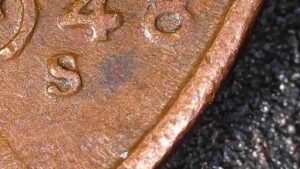
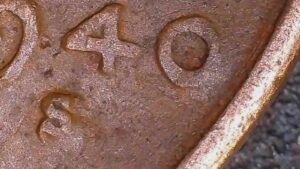
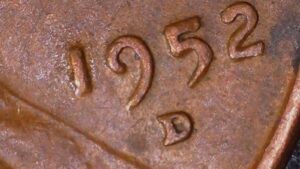
The error and variety chart, the key dates by denomination with catalog numbers, and the doubled dies - with photographs and sources cited.

Read more →

Case File

Open a question about a coin, gather the evidence, and record the verdict. “Nothing to see here” counts as a verdict too.

Read more →

Experimental

The speculative, geeky stuff that infers rather than measures, all in one place and clearly labeled. My favorite tab.

Read more →

The Real Thing

Caught Doing Its Actual Job

Every shot below is CoinScope Pro working on one coin, a 1955 doubled die cent. No mockups, no renders. Tap any of them for a closer look.

Straight Talk

What You Can Count On

It Shows Its Homework

The grading assist and the counterfeit screen show what they found and why, so the call stays yours. Think second pair of eyes, not a grading service or an authenticator. And no photo can tell you what metal a coin is made of, so it never pretends to.

It Keeps Working

Your key is checked once, when you activate it, and after that the program runs offline for good. No check-ins, no server to go down on you. And if a trial ends without a key, export still works, so nobody gets locked out of pictures they can’t retake.

Your Coins Stay Home

No telemetry, no analytics, no tracking. A copy talks to me once, to start the trial or to activate a key, and that carries the key, the emailed code and a machine fingerprint. Never your photos, your collection or anything about what you own.

Clean Captures

Your images come out with no watermark. The only marks are on screen recordings of the program itself.

Guesses Wear a Label

When a tool infers instead of measures, it says so, on its own tab, with the reason it could be wrong printed right beside it. A measured number looks like a measured number.

Ordinary Files

Your photos are regular files in regular folders, named so a set reads as a set in Explorer, even with no software at all.

Pricing

One Price, Paid Once

Five days free first — a free account, no card. Then one license, and that’s the end of it.

Here's the math that makes my inner accountant happy: a heavy collection is hundreds or thousands of coins, and every one of them needs photographing, measuring, filing and pricing, for as long as you collect. You pay once, and after that every coin you add is free. Keep it five years and it works out to about 11 cents a day. That's less than one bad eBay purchase you didn't catch before you clicked Buy.

Five-day trial, no card required  ·  the license includes the collection database, the flip designer and the quick reference

Who Makes This

Written by a Photographer
Who Deals in Coins

Hi, I’m Jen. No team, no investors. A kitchen table, a microscope, four kids and a stack of coins that needs shooting before the week is out. I’m a photographer, I deal coins and I collect them, and I’m secretly (not very secretly) a science nerd. Every answer this program gives is one I have to stand behind myself, which is why it tells you when it’s guessing.

Read the Whole Story

  • Dealerhas to quote the answer out loud
  • Collectorwants to know which die, not just the price
  • Photographeryour captures are never watermarked
  • Coderfive rewrites before the 1955 was called correctly
Download

Put a Coin Under the Lens

Windows 10 and 11, 64-bit. Any UVC microscope or webcam works. If Windows can see it, CoinScope Pro can use it. A graphics card is optional; it just makes the 3D viewer, the depth map and the Precision Compare alignment faster.

Download for Windows What Microscope Should I Buy?

Five-day free trial with a free account, no card. No telemetry, ever.

Reference

Look It Up Before You Measure It

Key dates, doubled dies, repunched mint marks and the markers that tell one die from another, free to read with no account. Plus the coins examined on this bench, with what turned up and what a photo couldn’t settle.

Coin Reference Coins Examined Here

Gen M.
Typically replies within a day
Hello, and welcome to CoinScope Pro. Click the button below to chat with us on Messenger.
Send a message